MathGov preserves the foundation. RippleLogic puts it into practice.
MathGov is the umbrella ethical-governance framework and public foundation. This site preserves its origin, governing commitments, civic archive, and release history. RippleLogic is MathGov’s rights-constrained decision architecture and operating method.
Begin with reality. Protect non-compensatory rights. Bound ruin. Test structural viability. Then rank only the options that survive. A later stage cannot rescue an earlier failure.
QUALIFY, THEN RANK
- Reality Grounding — establish an adequate evidence base
- Rights Floor / NCRC — exclude rights violations
- Tail-Risk Constraint — reject unacceptable catastrophic risk
- Structural Viability (CSV) — check capacity, reversibility, monitoring and system health
- RippleLogic Score (RLS) — compare qualifying options across affected welfare domains
Current public Canon v13.0 · SGP v8.8 · Release I. Read the formal standard for governing definitions and boundaries.
Reality. Rights. Ripples.
The 3R doorway explains what MathGov protects. The 1–2 rhythm explains how RippleLogic operates. Together they provide a clear public entrance to the full architecture without weakening its formal boundaries.
The architecture as an excavated stack.
The image presents the framework as layered discovery rather than a claim of ownership. Each level depends on the integrity of those beneath it; later ranking cannot repair an upstream failure.
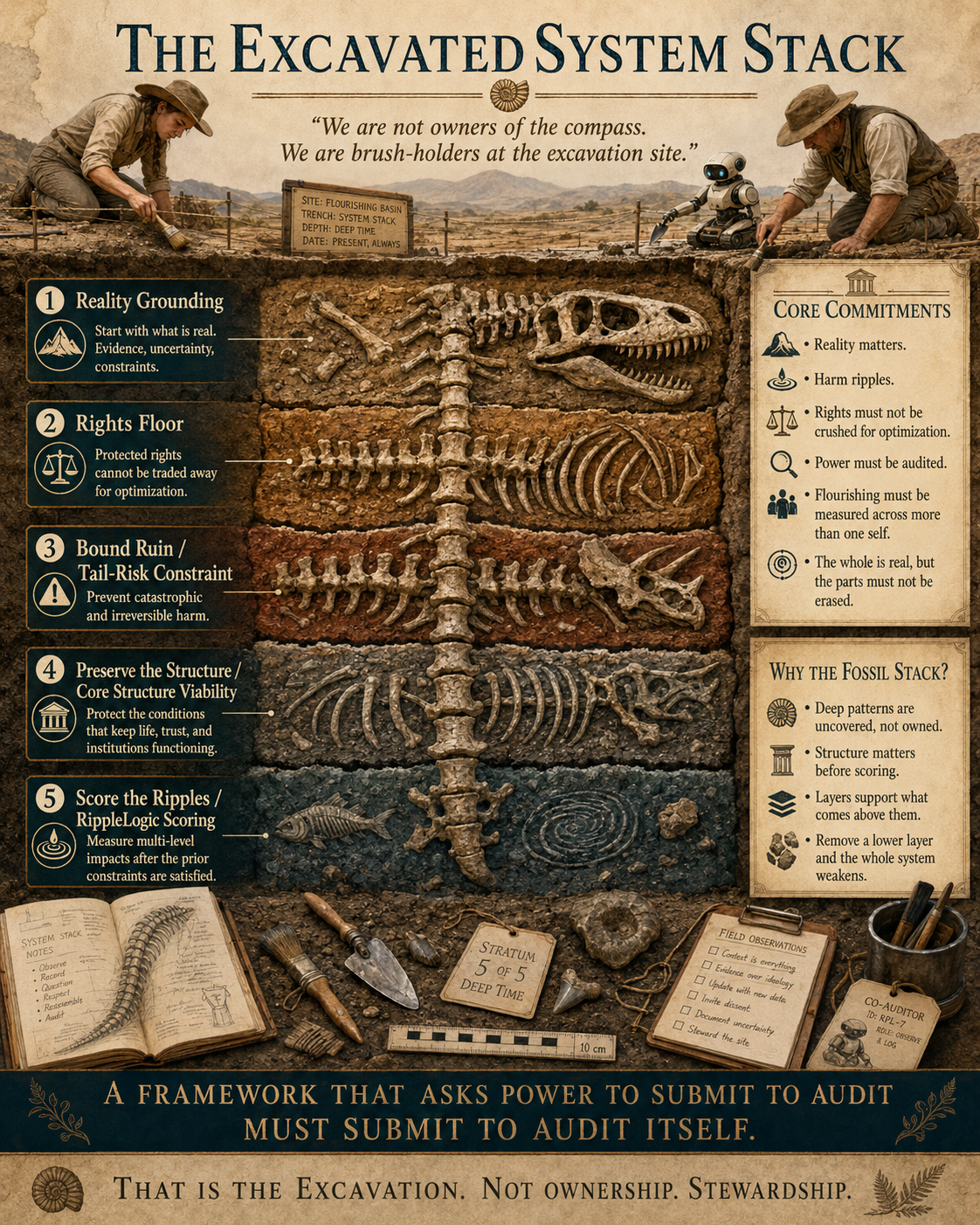
Public teaching image: qualification rests on prior layers; ranking begins only after they hold. Open the full-size image.
Open the source filesFive levels. Four qualify; one ranks.
Reality Grounding establishes claim authority. Rights Floor and non-compensatory rights constraints, Tail-Risk Constraint, and Containment & Structural Viability determine admissibility and selectability. The RippleLogic Score ranks only the surviving set.
Reality Grounding
Establish claim authority by declaring the reality surface, evidence trace, uncertainty, constraints, and claim boundary.
Rights Floor / NCRC
Protected and non-compensatory rights constraints cannot be traded away for optimization.
Tail-Risk Constraint
Bound catastrophic, irreversible, ruin-scale, and lock-in risks before benefit ranking.
Containment & Structural Viability
Check containment and whether the decision preserves the structures needed for life, agency, trust, and governance.
RippleLogic Score
Rank only the options that survive the qualification sequence.
Map consequences without flattening them.
The matrix maps seven union scopes across seven welfare dimensions so consequences can be located, reviewed, and audited instead of collapsed into one flat number.
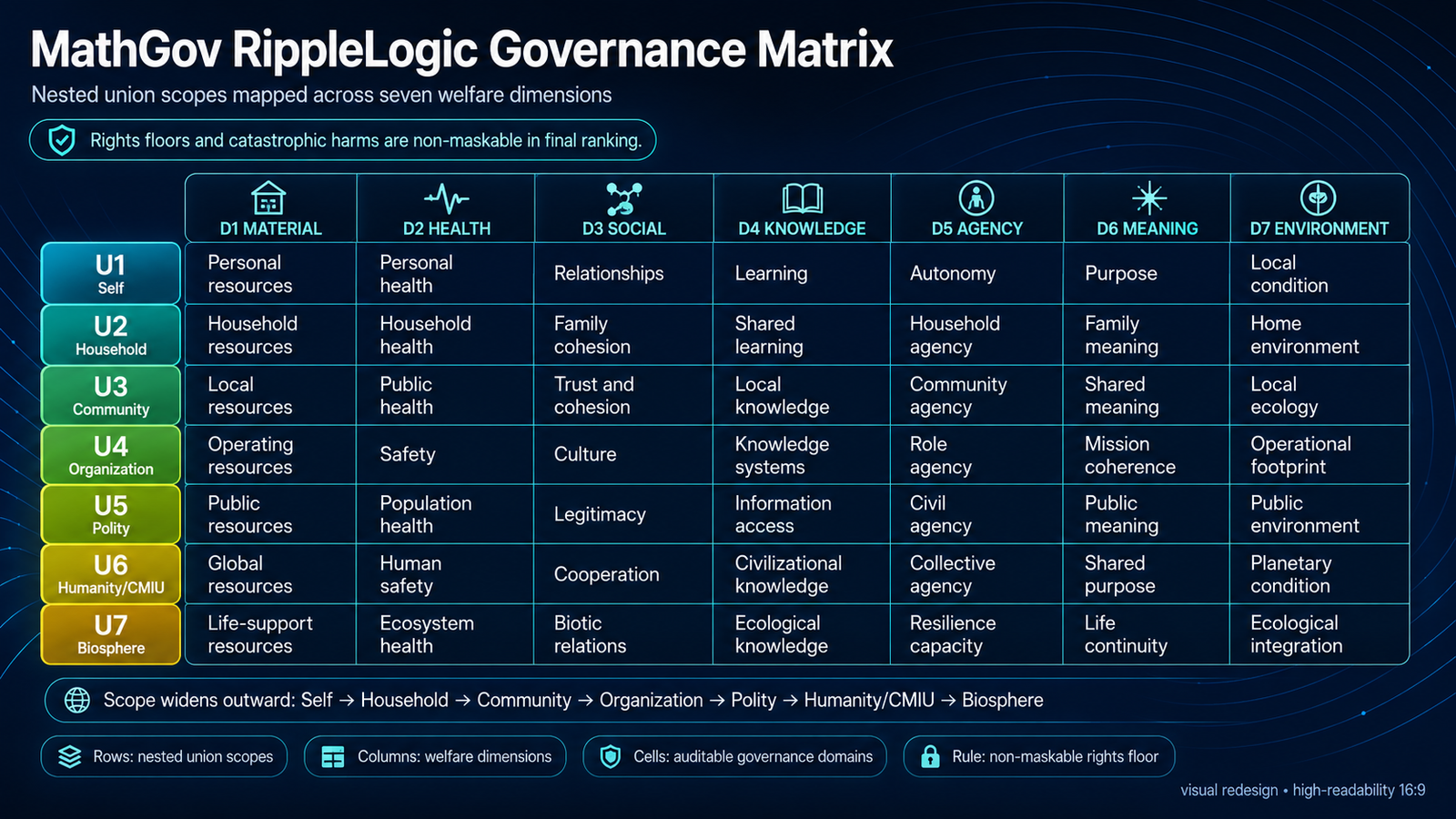
Matrix rule: welfare mapping supports auditability after RG establishes claim authority and RF/NCRC, TRC, and CSV qualify the option.
Six commitments that govern the work.
Generated or persuasive is not the same as grounded.
Consequences propagate across people, institutions, ecosystems, and time.
A high score cannot buy back a protected rights breach.
Authority, model confidence, and status must submit to traceable review.
Evaluation must look beyond one individual, organization, or short horizon.
The system cannot erase the vulnerable pieces it claims to serve.
Read the current Core 15. Follow every claim to its source.
Release I · 26 September 2026 · MG-RL-13.0-20260926-RELEASE-I. Read the accessible HTML, download a PDF, or inspect the original master. The 14 DOCX specifications govern under Canon/SGP precedence; the XLSX controls only its frozen worked example. Reading projections do not replace those masters.
Explore the wider body of work.
Each collection has its own scope, evidence, release record, and reuse terms. These related works do not replace the RippleLogic Canon or establish one another’s claims.
ORSH / AIU Research
ORSH is the historical Open Relational Substrate Hypothesis program label; AIU means Absolute Infinite Union. The current public collection examines frame-aligned records, locality and philosophical foundations. The reading collection distinguishes numerical or empirical models from philosophical interpretation; revised manuscripts are separately subject to review.
Explore ORSH / AIU researchAuditable Flourishing
Current published core protocol (104 pages) and separately labeled methods submission draft (12 pages). Read the evidence boundaries and source materials; no completed external validation is claimed.
Read Auditable FlourishingAIAP v6.5
Open-publication edition 1: software and schemas under Apache-2.0; author-owned papers, workbooks and research materials under CC-BY-4.0. Research version 6.5 is unchanged.
Open AIAP v6.5MHIOS v2.1
Human-interface and orchestration companion pinned to all 15 Core v13.0 Release I files and SGP v8.8. Standard, workbook, schemas and bounded record checks; Apache-2.0. Local consistency does not establish authority or deployment readiness.
Open MHIOS v2.1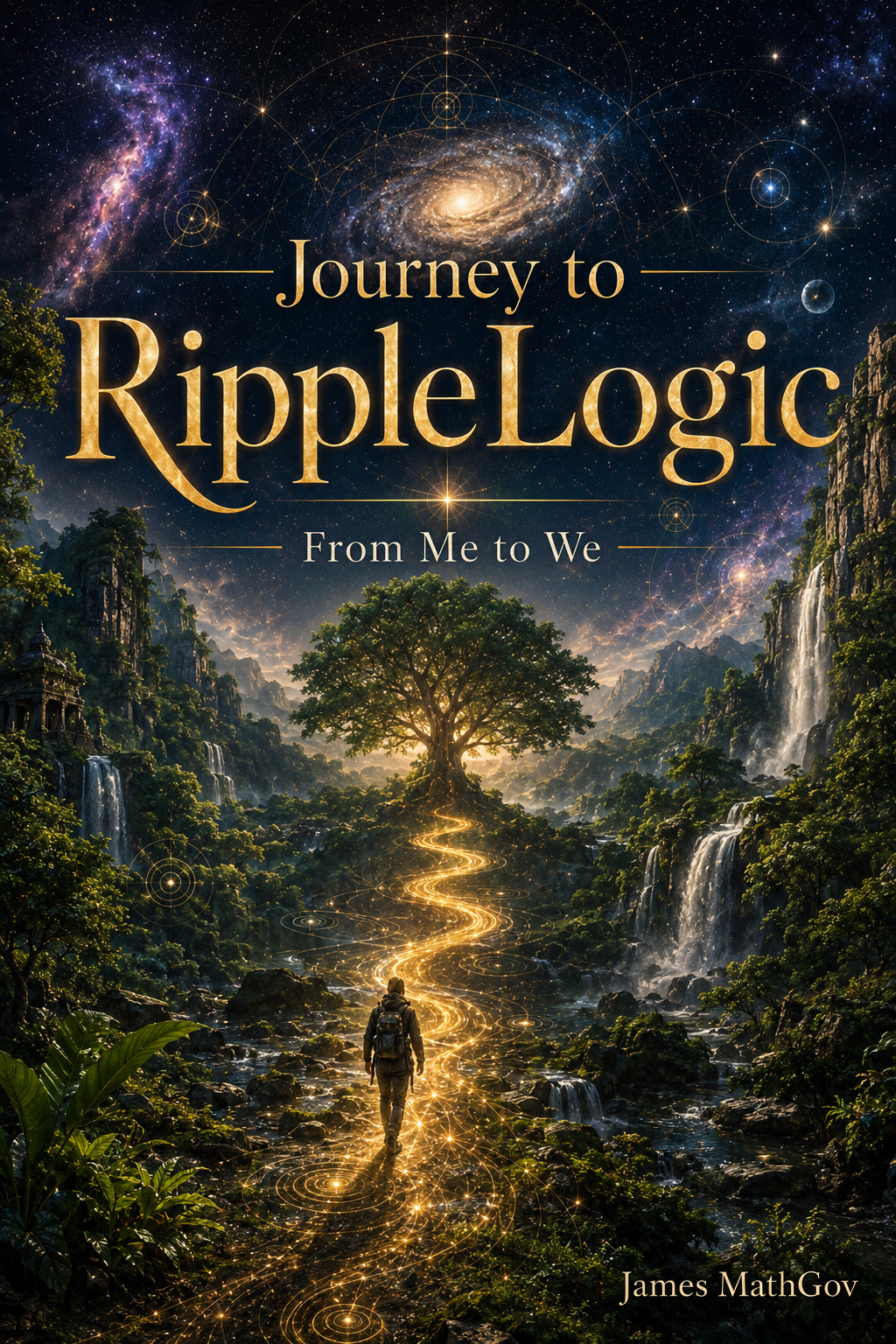
Journey to RippleLogic: From Me to We
The finalized current manuscript is Journey to RippleLogic v7.0, with a verified web-release candidate prepared. The linked public reader still serves v6.5 until the versioned v7.0 files are hosted and checked. Earlier editions remain archived.
Explore the bookAudit, reproduce, contribute
Release records, known limitations, source hierarchy, issue reporting, and contribution guidance.
Open Audit, reproduce, contributeORSH / AIU: choose a paper
- Frame-Aligned Records v0.5
- Technical Supplement v1.2
- Post-Injection Results v1.2
- P01 Protocol v1.3
- Absolute Infinite Union v1.4 — philosophical work
Numerical reproduction is not proof of the philosophical interpretation, consciousness, or a physical spacetime theory. See the collection’s evidence statement and reproduction instructions.
Research, books, origins and new publications.
Open inquiry carried forward across generations. Read the current sources, examine their limitations and contribute to what comes next. Research candidates are not presented as adopted or independently validated.
Research & Publications
Explore public governing sources, published research and carefully labeled review candidates.
Browse publications →Books & Education
Read the available book and see the educational material being prepared for release.
Explore books →MathGov Origins
Discover the 2010 university honors thesis and the separate contemporary reassessment project.
Read origins →Published Commentary
Read both GFiles India articles at their original publisher.
Read commentary →Universal Intelligence Alignment Constitution
Read the proposed Constitution’s purpose and review status. Not adopted or legally binding.
Explore proposal →About James MathGov
The research steward, public collaboration and accountable scholarship.
About the programme →Strong architecture requires an honest boundary.
MathGov and RippleLogic ask power to submit to audit. The framework must submit to audit itself.
What this release is
- A specified, versioned, auditable public decision architecture
- A publication-ready stabilization release with a fixed five-stage cascade
- A reproducible public research package with source, schemas, tests, release records, and challenge paths
- A foundation for independent replay, inter-rater studies, measurement work, and bounded pilots
- Reuse terms are collection-specific: consult each repository’s LICENSE and NOTICE. ORSH / AIU author-owned text and figures use CC BY 4.0; original code uses Apache 2.0, subject to third-party notices.
What this release is not
- Not a claim of empirical superiority or completed external validation
- Not legal, medical, engineering, safety, procurement, or deployment certification
- Not a consciousness detector or metaphysical proof
- Not automated moral truth or autonomous governance authority
- Selection does not itself create authorization, capability, permission, or physical executability
Release I supplies a bounded research package, not a completed external validation study. Some external registries and full conformance corpora remain unbundled or unverified; Release I did not perform a new native Excel recalculation/save/reopen check. Read the publication status and conformance boundary before reuse.
Ideas for accountable public decisions.
Two GFiles India articles, linked to the original publisher. Select anywhere on a card to read.

Can Mathematics Fix Governance?
From Discretion to Disciplined Judgment: evidence, protected rights, serious risks and practical viability in public decisions.
Published commentary · Original publisher linked
Read on GFiles India ↗
Can Citizens See How Government Decides?
Public decision records that make purpose, evidence, impacts, objections and review easier to examine.
Published commentary · Original publisher linked
Read on GFiles India ↗Cards open the original publisher in a new tab. Original attribution, dates and applicable rights remain unchanged. Commentary is not independent empirical validation of RippleLogic.
Tap/click the enlarged image or dark background to close. X and Escape also work.